

Let’s determine the right security solution for your needs together
Contact Us

In an addressable fire alarm system every device on the line is identified individually. The system is also referred to simply as an addressable fire panel installation; both terms describe the same technology.
When an alarm is raised, the panel names the device rather than a zone: "3rd floor, boiler room entrance, smoke detector 47". The team goes straight to that point. A conventional panel would only report "Zone 4", leaving that zone to be walked.
The difference is the time gained during a fire. In a small building, walking a zone takes seconds; in a 40,000 m² hospital the same search stretches into minutes. That is the reason addressable systems exist.
In an addressable system, devices are connected on circuits called loops. A loop leaves the panel, passes through every device and returns to the panel. This closed-circuit arrangement brings an advantage: if the line is cut at any point, devices continue to be fed from both ends and the system keeps working.
A single loop typically carries up to 254 addresses. That figure includes detectors, call points, sounders and input/output modules together.
In practice a loop is never filled to capacity. To leave room for future devices and to keep voltage drop under control, an 80% loading limit is applied — roughly 200 devices per loop.
The loop count determines the panel. Models with 1, 2, 4, 6 and 8 loops are common:
Loops are not shared between blocks; each block connects to its own panel or its own loop.
A closed loop alone is not enough. If a short circuit occurs on the line — a faulty detector, a crushed cable — that fault can silence the entire circuit.
A short-circuit isolator limits that risk. It detects the fault, disconnects the affected section and lets the remaining devices carry on. The panel reports which two isolators the problem lies between.
Isolators may be added to the line as separate devices, or built into detectors and call points. With built-in isolators every point protects itself; there is no need to buy separate units or find mounting positions for them.
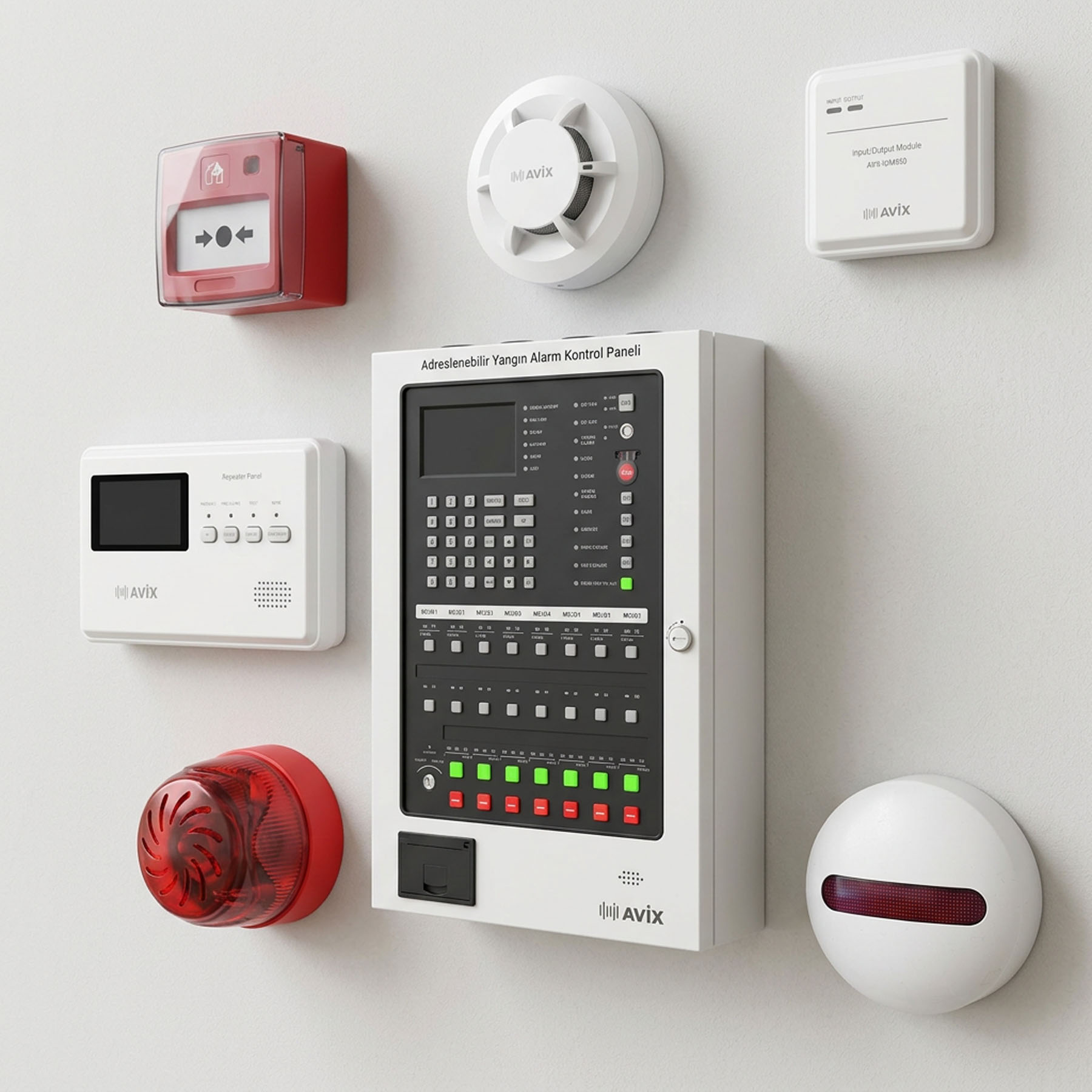
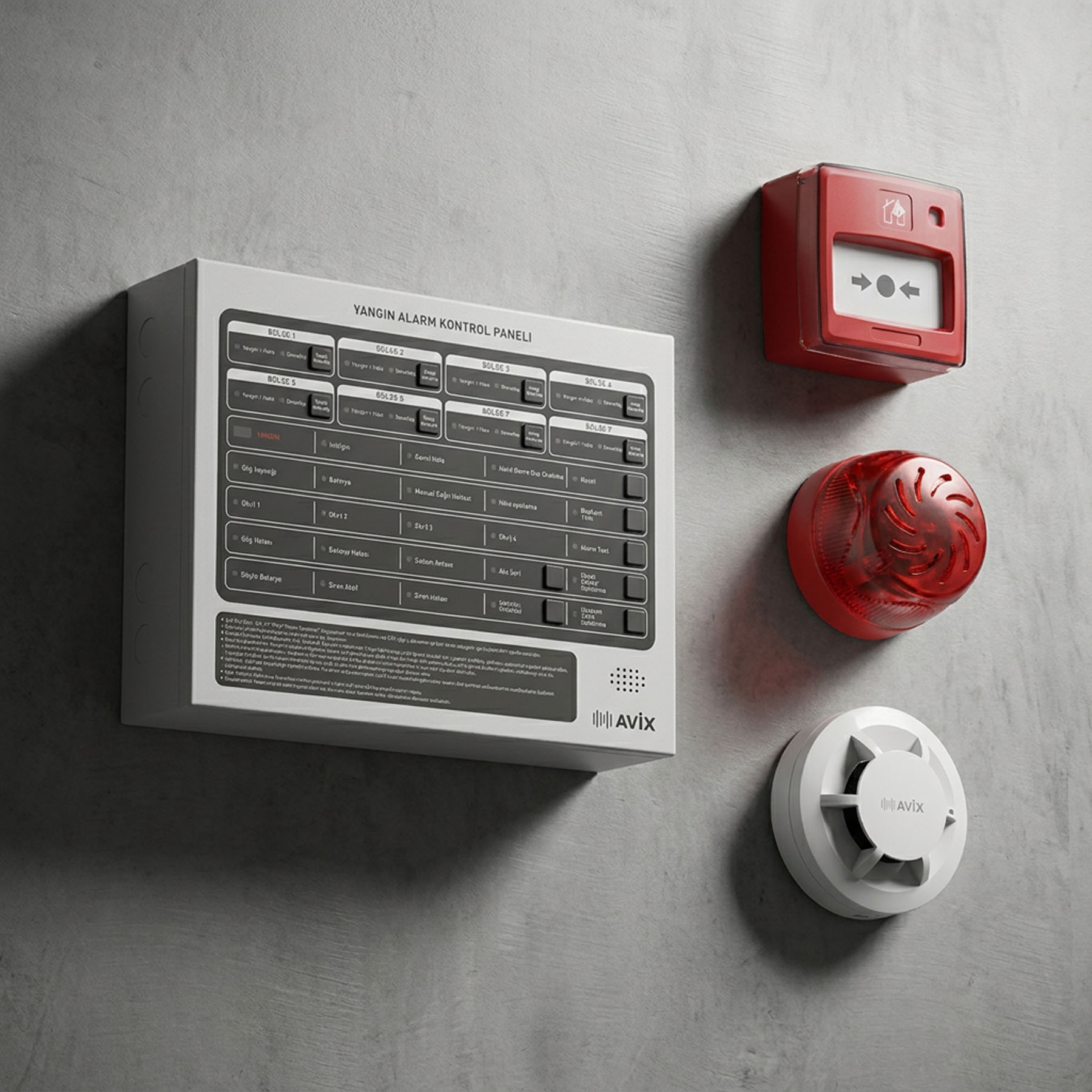
Drives the loops, monitors every device individually, logs alarms and faults and executes cause-and-effect scenarios. The location of an event appears on the display in plain text. On mains failure the system must remain in standby for 24 hours and then sound the alarm for 30 minutes.
Mirrors the main panel display at a second location — security office, reception, fire brigade entry point. In large buildings, running to the main panel costs time.
Each works with its own address. The panel monitors not only alarms but also contamination level and communication status. A detector that is getting dirty raises a maintenance warning before it ever causes a false alarm — something a conventional system cannot do.
A multi-sensor detector combines optical smoke and heat sensing. Because it evaluates both readings together, it is more resistant to false alarms.
Call points are addressed on the loop as well, so the panel shows exactly which one was operated. Sounders can be driven from the loop without a separate circuit, which simplifies the cabling.
These let the system talk to other building services. An input module monitors an external contact: sprinkler flow switch, fire damper position, generator status. An output module issues commands: send lifts to ground level, close fire dampers, stop ventilation, release magnetic door holders.
These modules are what actually build the fire strategy.
A programming device that writes addresses to units before installation. When addressing is planned properly, the list on the panel matches the physical layout on site, which makes maintenance and fault-finding far easier.
The decision comes down to building size and search time.
An addressable system is required when: device counts run into the hundreds, the building is large and complex, the location of a fire must be known within seconds, cause-and-effect scenarios are needed with other services, or every device has to be monitored individually.
Hospitals, shopping centres, high-rise buildings, hotels, factories, data centres and campuses fall into this group.
A conventional system is sufficient when: the zone count stays within eight, floor plates are small and zones are easy to walk. Small business centres, apartment blocks and workshops fall into this group.
Growth should be considered when planning the cabling infrastructure; converting later costs more than building the right infrastructure from the start.
The least discussed but most valuable aspect of an addressable system is cause-and-effect management. The panel does more than sound alarms — it governs how the building behaves during a fire.
In a typical strategy, when an alarm is confirmed:
These steps are built with input/output modules and communication interfaces. It is not enough for each system to work correctly on its own; they have to behave correctly together.
Because an addressable system monitors itself, maintenance is more targeted. The panel records which device is becoming contaminated and which circuit has drifted; the technician goes straight to the point instead of sweeping the whole building.
A service visit covers: review of event and fault logs, reading device contamination levels, sample smoke and heat testing, call point tests, sounder level measurement, testing of cause-and-effect outputs, battery voltage and capacity checks, loop voltage and resistance measurement, isolator tests and reporting.
We provide design, installation, commissioning and scheduled maintenance for both addressable and conventional fire detection systems. We also carry out integration work with CCTV, access control and intruder alarm systems.
Get in touch for a loop plan, a bill of materials and a budget figure for your project. We also carry out site surveys for the extension or replacement of existing systems.