

The most common mistake in gas detection is not in choosing the device but in mounting height. A detector fitted at the wrong height gives the same result as no detector at all: the leak happens and the device never sees it.
This article covers where each gas collects and how the detector is positioned accordingly.
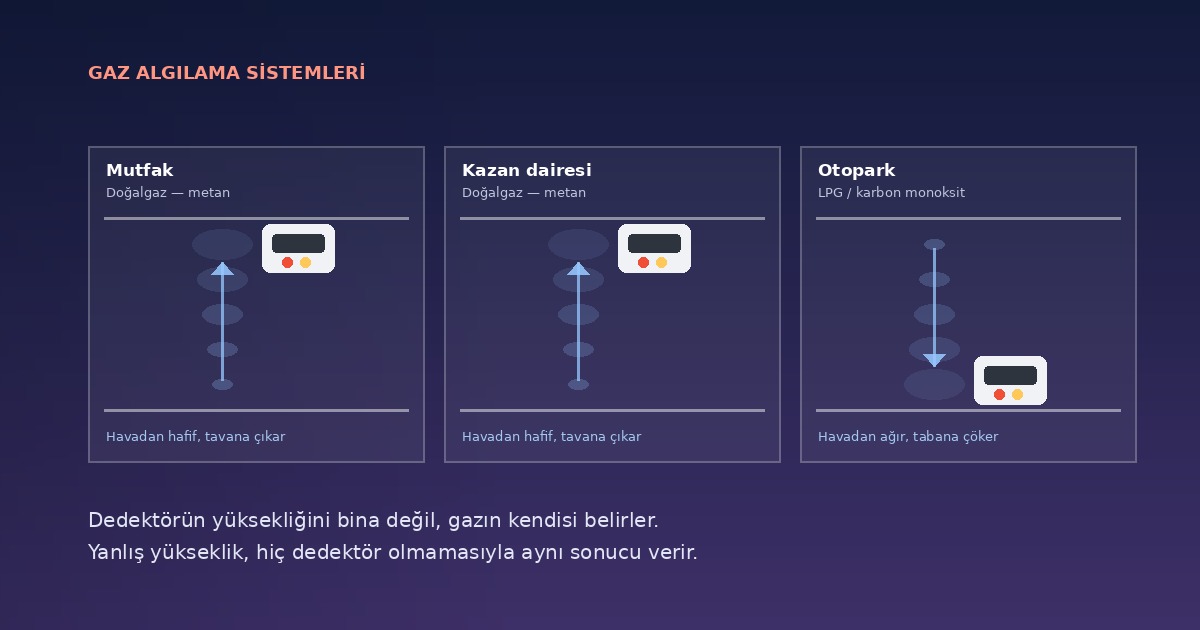
The gas sets the height, not the building
Every gas has a density relative to air. Gases lighter than air rise and collect at ceiling level; heavier ones sink and gather at floor level. The detector has to be where the gas accumulates.
Methane (natural gas). Lighter than air, it rises to the ceiling. The detector is positioned near the ceiling, typically 30 cm below it. Kitchens, boiler rooms, heating plant and any technical space using natural gas fall into this group.
LPG (propane, butane). Heavier than air, it sinks to the floor. The detector is positioned near floor level, around 30 cm above the floor. LPG kitchens, cylinder stores and car parks admitting LPG vehicles fall into this group.
Carbon monoxide. Its density is close to that of air and it disperses through the space. The detector is positioned at breathing height, around 1.5 metres above the floor. Enclosed car parks, generator rooms and spaces with combustion products fall into this group.
All three gases may be present in the same building, and each calls for a different height. One mounting height cannot serve all three.
Distance to the source of the leak
Even at the correct height, a detector far from the source will respond late. Detectors are positioned close to the likely leak point: the gas valve, the burner, the cylinder connection, the regulator.
Standard practice is to consider a separate detector for each potential source. In large spaces the coverage depends on air movement; immediately beside a ventilation grille is a poor location, because the airflow disperses and dilutes the gas.
Alarm threshold: what LEL means
For flammable gases the threshold is expressed not as an absolute concentration but as a percentage of the LEL (Lower Explosive Limit) — the lowest concentration at which the gas-air mixture becomes ignitable.
Systems normally operate in two stages: the first alarm at 10 per cent of LEL and the second at 20 per cent. Warning is therefore given long before an explosive mixture is reached.
For carbon monoxide the threshold is not set by LEL but by health limits in ppm (parts per million), because the hazard there is poisoning rather than explosion.
What should happen on alarm
A gas detector on its own is a warning device. Its real value comes from what it triggers:
- The solenoid valve closes. The gas supply is cut. This is the most critical output of a gas detection system.
- Ventilation starts. Gas in the space is diluted.
- Audible and visual warning operates. Anyone in the space evacuates.
- The fire panel is notified. Where central monitoring exists, the condition is passed to the panel.
A gas detection system that does not close the valve only reports the leak. It does not stop it.
Sensor life and calibration
This is the most important difference between gas detection and fire detection. Gas sensors are consumed.
Electrochemical and catalytic sensors have a limited working life, typically three to five years. Once that life is over the device still appears to work and its LED still lights, but it no longer detects the gas.
Gas detectors are therefore calibrated periodically: test gas of a known concentration is applied and the device is verified to respond correctly. Sensors at the end of life are replaced.
Where cleaning is sufficient for a fire detector, calibration and sensor replacement are mandatory for a gas detector. This schedule should be handed to the client in writing at installation.
Which spaces need them
Kitchens on natural gas. In commercial kitchens, the more hobs, ovens and grills, the higher the leak risk.
Boiler rooms and heating plant. Burners, valves and pipe connections are concentrated in one space.
Enclosed car parks. For carbon monoxide; and additionally for LPG where LPG vehicles are admitted.
Generator rooms. An exhaust leak creates a carbon monoxide risk.
Industrial facilities. Production lines using process gases, paint shops, filling plants and storage areas.
Three common mistakes
One height for every gas. The electrician fits all detectors in line with each other. A methane detector at floor level is useless; an LPG detector at ceiling level is useless.
No calibration schedule. The system is installed and nobody mentions sensor life. Five years later the devices are all still in place and none of them works.
No valve connection. The detector alarms, the sounder operates, and the gas keeps flowing. Without the solenoid valve wired in, the system is only half built.
Summary
Choosing the right device is the easy part of gas detection. Three things determine the outcome: mounting height suited to the density of the gas, an output wired to a solenoid valve, and a calibration schedule that is actually followed.
Without these three the system looks installed but does not work.
For gas detector siting and device counts in your building, you can request a free site survey.
