

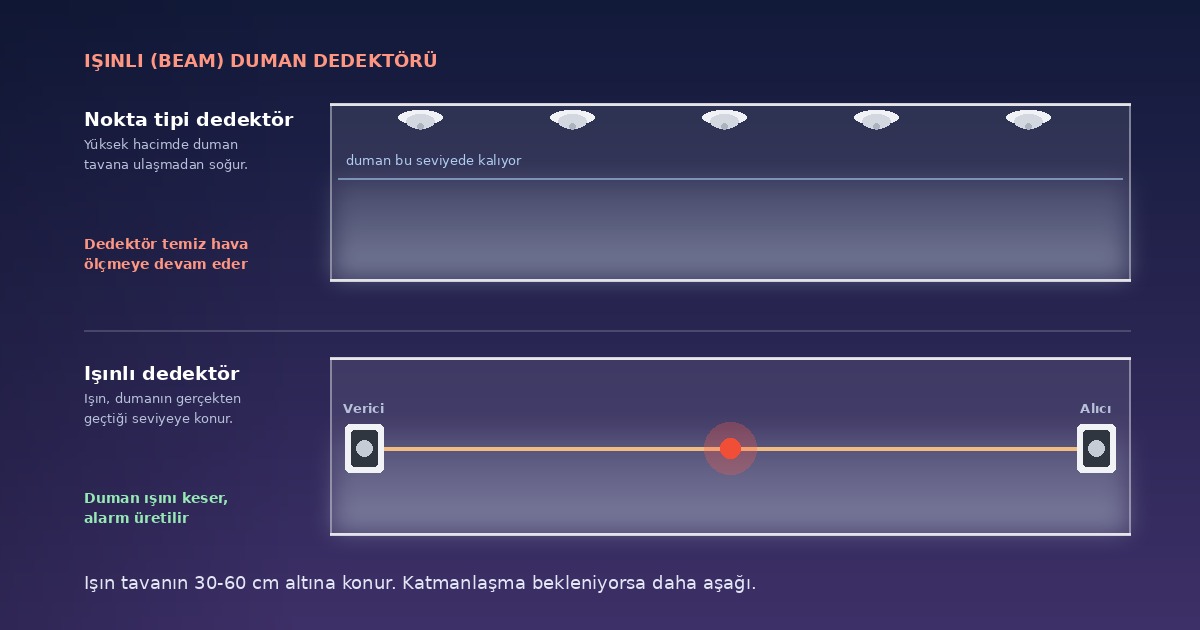
A point smoke detector is fixed to the ceiling and waits for smoke to reach it. The higher the ceiling, the longer that wait becomes, and past a certain height it never happens at all.
A beam detector solves this by not waiting: it uses a light beam that spans the space from one end to the other.
How it works
The system has two parts: a transmitter projects an infrared beam and a receiver on the opposite wall continuously measures it. When smoke enters the beam path the light is attenuated and the device raises an alarm.
Some models combine transmitter and receiver in one housing, with only a reflector fitted on the opposite wall. This simplifies installation because power and cabling are needed at one point only.
Beam detectors fall under EN 54-12. This is a separate product category from EN 54-7, the standard for point detectors.
Why point detectors fall short at height
The reason is stratification.
Hot smoke rises, but as it rises it cools, and it stops where its density matches that of the surrounding air. It never reaches the ceiling; it hangs in the space as a layer.
This happens particularly in tall spaces and in buildings with a hot air layer beneath the roof. In a warehouse where the roof space heats up in summer, smoke may never reach the ceiling at all. The detector up there goes on measuring clean air.
Because a beam detector forms a horizontal line just below the ceiling, it is enough for the rising smoke to cross that line. And where necessary, the beam can be positioned lower, at the level where the layer actually forms.
Above what height
Under CEN/TS 54-14, point smoke detectors are suitable up to a ceiling height of 12 metres in standard conditions, and up to 16 metres in special cases.
In practice, beam detectors are recommended for spaces above 7 metres. Staying below that limit is technically possible but detection takes longer.
Beam detectors are used up to 16 metres in standard conditions. Between 16 and 45 metres, suitability is assessed according to how the fire is expected to develop and how the smoke will behave.
How much width is protected
This figure changed in the 2018 version of the standard and is the one most often misremembered on site.
The detection radius of a beam detector is 6.2 metres. Protection extends 6.2 metres either side of the beam, giving a total protected width of 12.4 metres.
In the earlier version these figures were a 7.5 metre radius and 15 metres of width. A designer working from an old table will come up short on detector count today.
Against that, beam length was increased: the previous 25 metre limit was raised to 45 metres, subject to positive test fire results. Manufacturers typically quote operating ranges up to 100 metres, and more on some models.
The two numbers should not be confused: operating range is how far the device can project its beam; protected area is calculated under the standard.
Mounting height
The beam is positioned 300 to 600 mm below the ceiling, parallel to it. This range keeps the hot air layer beneath the ceiling from interfering with the beam.
In very tall spaces such as atria, CEN/TS 54-14 recommends siting beam detectors between 9 and 12 metres above floor level. In other words the beam is not always placed at the very top; it is placed where the smoke will actually travel.
In very tall spaces it is common practice to use beams at more than one level: one high up, and one at the level where stratification is expected.
Where they are used
Warehouses and logistics centres. In high-bay warehouses the ceiling reaches 10 to 15 metres. Protecting that with point detectors is both expensive and ineffective.
Production facilities. Wide-span production halls. Maintenance matters here too: cleaning a point detector at 12 metres needs a platform, while a beam detector only requires access to two end points.
Sports halls and indoor pools. Wide, tall, uncompartmented spaces.
Atria and shopping centres. Tall voids connecting several floors.
Historic buildings. Where running cable and drilling into the ceiling is a problem, mounting at two end points is enough.
Aircraft hangars and terminals. Scales at which point detection is simply impractical.
Alignment: the critical point
The transmitter and receiver have to see each other. Alignment is done at installation, but the real problem appears later.
Structural movement. Steel-framed buildings expand and contract with temperature. A few millimetres of movement between summer and winter is enough to break alignment over 80 metres. This is why modern devices apply automatic alignment compensation.
Vibration. In production facilities machine vibration gradually shifts the mounting point. The device is fixed to a solid structural element, preferably a column.
Obstruction of the beam path. Racking is raised in a warehouse, a crane passes through, a suspended panel is fitted. The beam is broken and the device reports a fault. A clear beam path has to be guaranteed from the outset.
Contamination. In dusty environments the lens surface gets dirty over time. Good devices compensate for that slow change and report a fault once a defined threshold is crossed. Periodic cleaning is required.
Three common mistakes
Calculating with the old spacing figures. A 7.5 metre radius and 15 metres of width belong to the previous version of the standard. The current figures are 6.2 and 12.4 metres. In a wide hall that difference amounts to one missing beam line.
Mounting at the very top of the ceiling. In buildings where stratification is expected, the beam ends up at a level the smoke never reaches. The height is calculated, not assumed.
Mounting on a vibrating surface. Fixing to sheet cladding, a suspended ceiling or light framing will break alignment within months and produce constant faults.
Maintenance
Three things are checked at the annual service of a beam detector:
- Lens cleaning. Transmitter and receiver surfaces are cleaned.
- Alignment. The signal level is read and the device realigned if necessary.
- Functional test. A calibrated filter is placed in the beam path to prove the alarm and fault thresholds.
Results are entered in the logbook. A year-on-year drop in signal level is an early indication of lens contamination or structural movement.
Summary
A beam detector works where a point detector cannot reach. But its advantage comes not from coping with height as such, but from being able to sit at the level the smoke actually passes through.
A correctly sited beam line does what ten point detectors cannot. A beam line installed at the wrong height does nothing at all.
To assess a detection solution for a high-ceilinged building, you can request a free site survey.
